Improving Surface Finish on Pre-Hole for M22 × P2 Thread Milling by NC Helix Drill
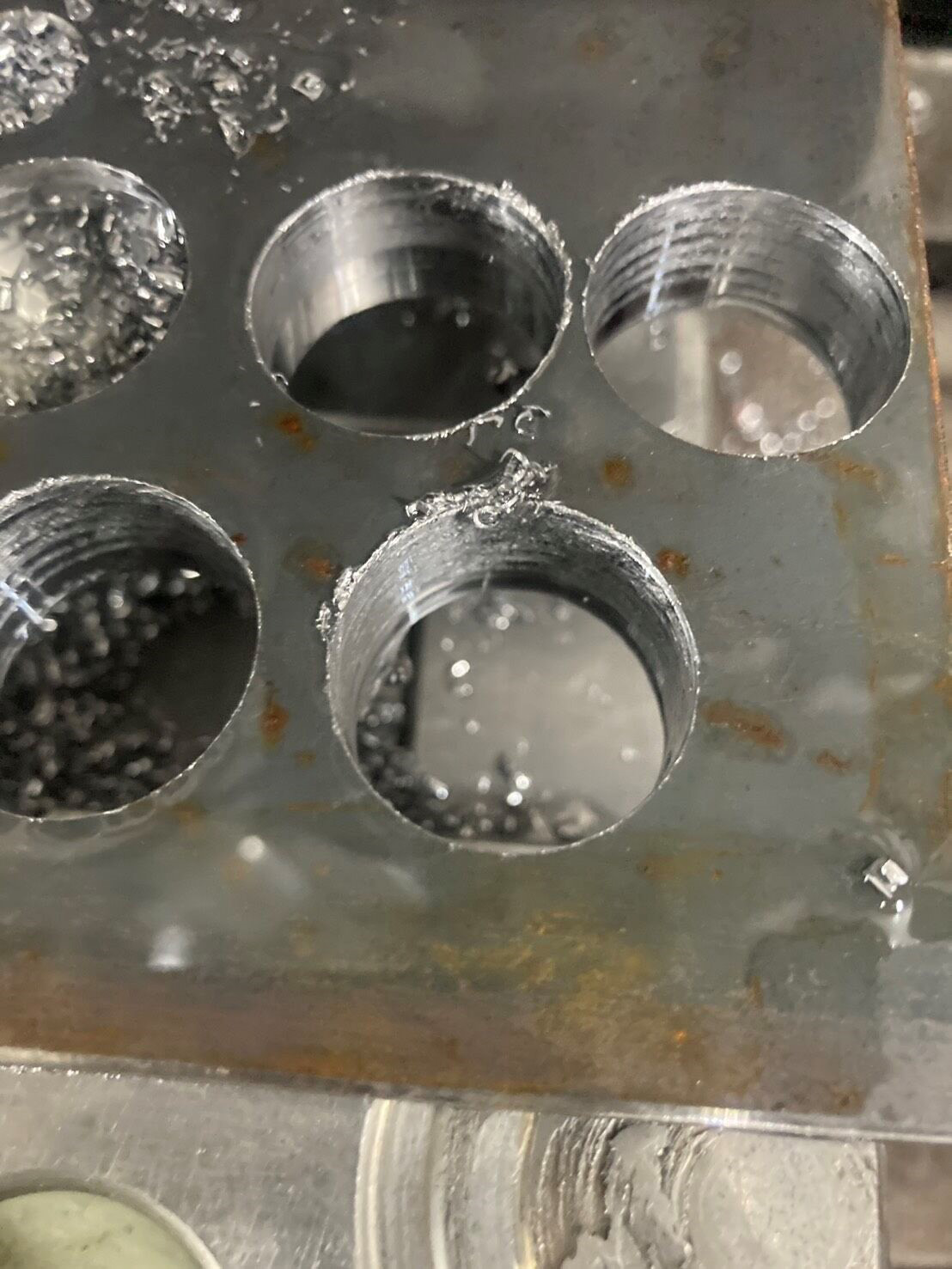
| NC Helix Drill :From Testing to Optimization Improving Surface Finish on Pre-Hole for M22 × P2 Thread Milling (Stainless Steel) An NC Helix Drill was used to prepare the pre-hole prior to M22 × P2.0 thread milling (tolerance class 2). Functionally, the thread could already be assembled successfully. However, to meet higher quality expectations, surface finish—especially at the thread and tool exit area—required further improvement. This led to the following test series. ➡️ Scaling Up – Where Surface Finish Became Critical When machining larger diameters equivalent to M22 size: *Cutting load remained stable *Step marks and burrs appeared at the tool exit  This clearly indicated that the limitation was not cutting force, but exit behavior and pitch interaction, which directly affected surface finish. This clearly indicated that the limitation was not cutting force, but exit behavior and pitch interaction, which directly affected surface finish.➡️ Parameter Adjustment – What Actually Helped *Increasing cutting speed from 60 to 90 m/min provided only limited improvement. However, reducing the pitch to 2.0 resulted in: *Significant reduction of burrs *Only a minor step at the point where cutting conditions were reduced to 50% at tool exit This confirmed that pitch selection is a more effective lever than speed alone when surface finish is the priority.➡️ Productivity Check With optimized conditions established: *Cutting parameters were increased by +10% via override *Stable cutting behavior was maintained This confirms that quality improvement and productivity do not have to conflict, when the process window is properly defined.➡️ Key Insights for Machining Stainless Steel Pitch optimization can be more impactful than increasing cutting speed. Once surface integrity is controlled, there is room for productivity gain ➡️ Conclusion These tests underline a practical reality in precision machining: Successful assembly is the baseline; refined surface finish is the real differentiator.Recommended Cutting Summary Tool: 99321-012-1525 Cutting speed: ~90 m/min Spindle speed: ~2,200 rpm Feed rate: 220–265 mm/min Feed per revolution: 0.10–0.18 Pitch: 2.0–2.5 Coolant: Water-soluble, directed at the cutting edge Through systematic testing and parameter optimization, stable and high-quality machining in stainless steel can be achieved with confidence. ►► More information about NC Helix Drill |
 |